Norwegian Antarctic Territory
 Adopted 14 Jan 1938
|
|
Map
of
Queen Maude Land
|
Hear National Anthem
"Ja, vi elsker dette
landet"
(Yes, We Love This
Country)
|
Text
of
National Anthem
|
Constitution
(17 May 1814)
|
Administrative
Seat:
Oslo, Norway
Chief Stations: Troll
(from 17 Feb 1990), and
Tor (from 1992);
(Norway Station 1956-1960,
Maudheim 1949-1952)
|
Currency:
Norwegian Krone
(NOK)
|
National
Holiday:
17 May (1814)
Constitution Day
|
Population:
Uninhabited
Seasonal Research
Staff
Summer (Dec.-Feb.): 60
Winter
(Jun.-Aug.): 7
(2024)
|
Total Armed
Forces: N/A
Defense is the
Responsibility of Norway
Merchant marine:
None (2024)
|
Number of
Year-round Stations: 1
Summer-only
Stations: 1
(2024)
|
GDP: $N/A
|
| International
Organizations/Treaties: None |
Norwegian
Antarctic
Territory
Index
|
Chronology
- 1 Jan
1739
Bouvet
Island is discovered by French
Capt. Jean-
-
Baptiste Charles Bouvet
de Lozier (b. 1705
-
-
d. 1785), of
the Aigle.
- 27
Jan
1820
Queen Maud Land was the first part
of Antarctica to
-
be sighted, by Russain Adm.
Fabian Gottlieb von
-
Bellingshausen
(Faddey Faddeyevich Bellinsgauzen)
-
(b. 1778 - d. 1852).
- 21 Jan
1821
Peter
I Island discovered by Russian
explorer Adm.
-
Fabian Gottlieb von Bellingshausen
(Faddey
-
Faddeyevich Bellinsgauzen)(s.a.)
and named after
-
the former
Emperor Pyotr (Peter) I (O.S. date
-
9 Jan 1821).
- 16 Dec 1825
Bouvet Island claimed for Britain
by Capt. George
-
Norris,
of the sealer Sprightly,
he lands on the
-
island and names it
Liverpool Island, after the
-
Prime Minister.
- Nov 1893 - Mar 1894
Carl
Anton Larsen (b. 1860 - d. 1924)
discovers
-
and named Foyn Coast in Graham
Land, King Oscar II
-
Coast,
Mount Jason, and Robertson Island.
- 24 Jan
1895
Carsten Egeberg Borchgrevink (b.
1864 - d. 1934)
-
made the first landing on
Antarctica. Three years
-
later he led the first party to
winter on the
-
continent.
- 14 Dec
1911
Antarctic Plateau was claimed for
Norway by Roald
-
Amundsen (b. 1872 -
d. 1928), as the King Haakon
-
VII Plateau when his
expedition was the first to
-
reach the South Pole.
It was mapped as a circular
-
territory comprising
the plateau around the South
-
Pole, including all the land above
latitude 85°S
-
(not officially claimed by the
Norway).
- 1 Dec
1927
Bouvet
Island (Bouvetøya) claimed
for Norway by Lars
-
Christensen (b. 1884
- d. 1964).
- 1 Mar 1928
Norwegian Svalbard
and Arctic Ocean Survey (Norges
-
Svalbard-
og Ishavsundersøkelser)
founded.
- 19 Nov
1928
The British government waives its
claim to Bouvet in
favor of Norway.
- 1929 - 1930
Hjalmar Riiser-Larsen
leads the first expedition to
-
use aircraft
for research purposes, conducting
-
several
successful reconnaissance trips
over Queen
-
Maud Land. The
first flyover of the South Pole is
-
executed by
another Norwegian air pioneer,
Bernt
-
Balchen, on
28-29 Nov 1929.
- 2 Feb
1929
Peter
I Island (Peter I Øy) first
recorded landing on
-
the island by the Norvegia
expedition, which then
-
claims the island for
Norway.
- 29 Apr 1929
The first Norwegian
territorial claims in Antarctica
-
are made, following
many years of Norwegian
-
involvement in the exploration and
survey (further
-
claims are made 1931 and 1936-37).
- 28-29 Nov
1929
The first flyover of the South
Pole is executed by
-
Norwegian air pioneer, Bernt
Balchen (b. 1899 - d.
-
1973).
- Jan
1930
Queen Maud Land named for the King
Haakon VII's wife.
- 27 Feb 1930
Bouvet Island (Bouvetøya)
is declared a Norwegian
-
dependency.
- 1 May
1931
A royal proclamation places Peter
I Island under
-
Norwegian sovereignty (annexed 24
Mar 1933).
- 14 Jan 1939
Queen Maud Land (Dronning
Maud Land) in Antarctica
-
(45°E to 20°E), between the
British and Australian
-
claims, formally placed under the
sovereignty of
Norway.
- 19 Jan - 15 Feb 1939
The area 20°E
to 10°W is explored by a German
-
expedition led by
Alfred Ritscher (b. 1879 - d.
-
1963).
- Aug
1939
Germany announces the formation of
a German Antarctic
-
sector between
4°59' E and 16°30' E, called
-
Neuschwabenland
(New Swabia Land), which lays
-
completely
within the area that Norway
already
-
annexed; this
claim never receives international
-
approval and
is not raised again after World
War II
- 13 Jan
1941
German
commandos board and capture
two
-
Norwegian factory ships in the sea
north of
-
Queen Maud Land. By the end of the
next day,
-
the Germans had taken possession
of three
-
factory ships and eleven catchers.
German
-
Navy subsequently used the waters
of the
-
Peninsula and the sub-Antarctic
islands as a
-
haven from which they could
venture forth to
-
attack allied shipping.
- 1 Mar
1948
Norwegian Polar Institute founded
(part of Ministry
-
of
Trade and Industry, from 1978 the
Ministry
-
of the Environment) assigned to
administer the
-
Norwegian territories in the
Arctic and Antarctic,
-
including Queen Maud
Land.
- Feb 1950 - May 1951
The
Norwegian-British-Swedish Maudheim
expedition
-
explores the
area.
- 1956 - 1960
The Norwegian
Antarctic Expedition has its base
at
-
Norway Station (about
70°30' S, 2°30' W). This
-
station is afterwards
taken over by South Africa.
- 21 Jun
1957
Norway declares Dronning Maud
Land, Bouvet and
-
Peter I
Islands subject to
Norwegian sovereignty
-
as a dependency (Norwegian
Antarctic Territory).
- 1
Dec 1959
Norway is an original signatory of
the Antarctic
-
Treaty
(effective 23 Jun 1961). Norway
upholds its
-
claim to
sovereignty, but supports
international
-
cooperation.
- 23 Jun 1961
Peter I Island
becomes subject to the Antarctic
-
Treaty, but Bouvet Island remains
outside is area.
- 1967
Norway's role
in the Antarctic whaling industry
ends.
-
Due to
over-exploitation of whale stocks
in the
-
Southern Ocean.
- 19 Dec
1971
A royal decree declares Bouvet
Island and its
-
adjoining territorial waters a
nature reserve.
- 1 Jan
1978
The Polar Affairs Department (Polaravdelingen)
of the
-
Ministry of Justice
and the Police, in Oslo,
-
assigned the administration of the
Norwegian
-
polar areas including
Queen Maud Land, with the
-
advice of the Norsk
Polarinstitutt.
- Feb 1990
Troll research station
opened.
- 1992
Tor
research station opened.
- 5 May 1995
Norwegian law
has required all Norwegian
activity in
-
Antarctica, including
on Peter I Island, to follow
-
international
environmental law for Antarctica.
- 12 Feb 2005
Troll research
station, previously suitable only
for
-
summer use, reopens as an all-year
station.
- 12 Jun 2015
Norwegian Foreign
Ministry report to the Storting
-
notes that Norwegian
authorities "have not opposed"
-
any interpretation of
the Norwegian claim as
-
extending all the way to the South
Pole (previously
-
the southern extent
of the territory was often
-
depicted as undefined, ending in a
diffuse or wavy
-
line a short distance
from the pole or with a
-
coloring
"fading out" toward the south).
|
Bouvet Island
|
| Peter I Island |
| Map
of Bouvet Island |
| Map
of Peter I Island |
|
|
| |
| |
| |
| |
|
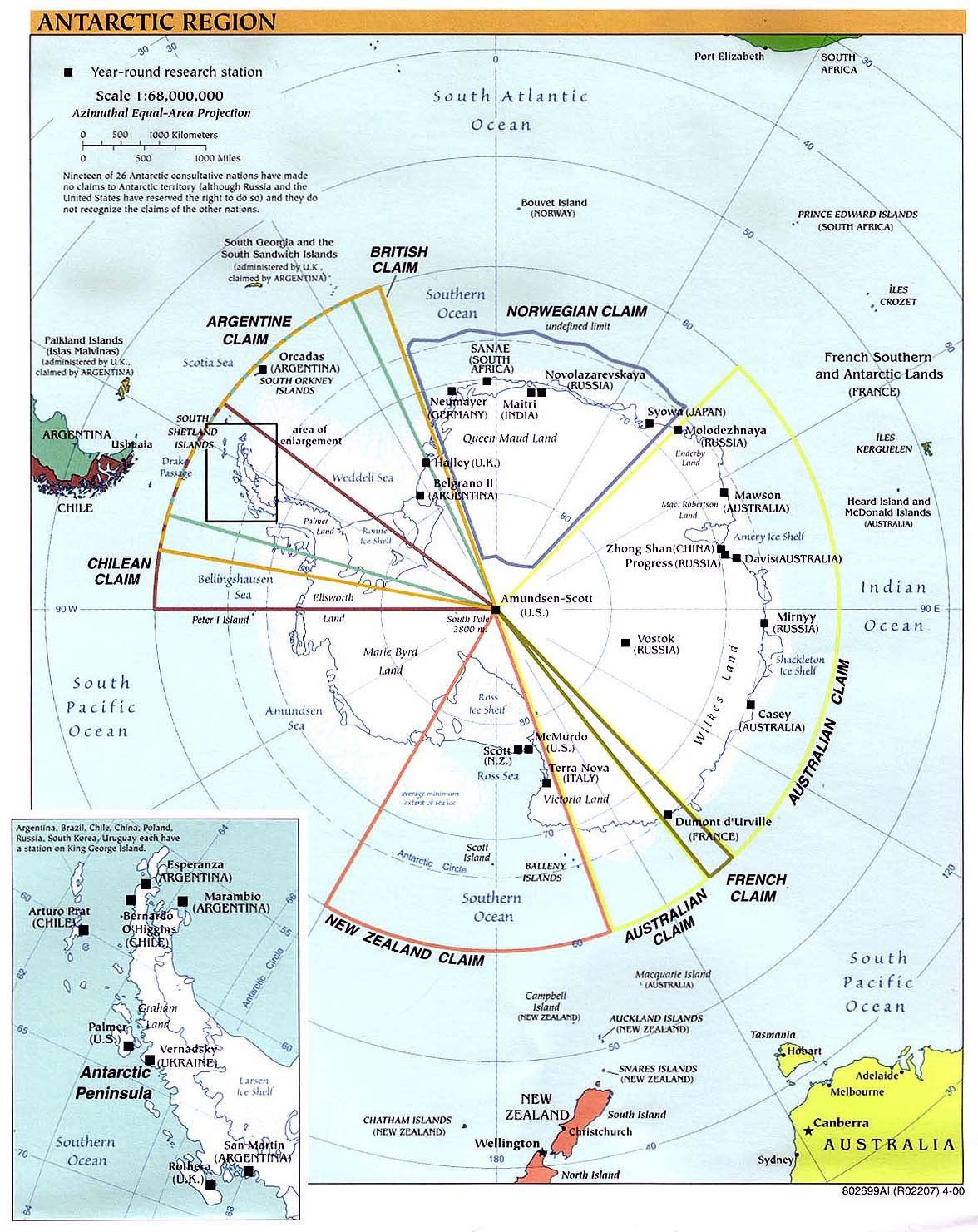
Note: Queen Maud Land (Dronning Maud Land)
is the sector of the Antarctic continent lying between
longitudes 20° W and 45° E claimed by Norway. It is
divided into the Princess Martha Coast, Princess
Astrid Coast, Princess Ragnhild Coast, Prince Harald
Coast and Prince Olav Coast. It borders the claimed
British Antarctic Territory 20 degrees West,
specifically the Caird Coast, Coats Land on the West,
and the Australian Antarctic Territory 45 degrees
East, specifically Enderby Land on the East. In
addition, a small unclaimed area from 1939 was annexed
in Jun 2015. Positioned in East Antarctica, it makes
out about one-fifth of the continent. It is composed
of a total area of 2,700,000 km sq (1,000,000 sq mi).
Peter I Island (Peter I Øy), a volcanic island
located located in the Bellingshausen Sea, some 450 km
(280 mi) north of the Antarctic mainland is also part
of the Norwegian Antarctic claim. Bouvet Island is a
volcanic island in the South Atlantic Ocean, some
2,400 km southwest of the Cape of Good Hope (South
Africa), but only 1,600 km north of Antarctica, south
of the Antarctic Convergence (thus by some definitions
within the Southern Ocean). Lying north of 60° S.
Bouvetis not encompassed by the terms of the Antarctic
Treaty.
Director Generals (Ekspedisjonssjef) of
the Polar Affairs Department (in Oslo)
1978 - ....
....
.... -
Øystein Mortensen
Heads of the
Norwegian Svalbard and Arctic
Ocean Survey
1 Mar 1928 - 1945
Adolf
Hoel
(b. 1879 - d. 1964)
1945 - 1948
Anders
Kristian Orvin
(b. 1889 - d. 1980)
Directors, Norwegian Polar Institute (Norsk
Polarinstitutt)
(in Oslo; from 1998 Tromsø, Norway)
1948 - 21 Aug
1957
Harald Ulrik Sverdrup
(b. 1888 - d. 1957)
1957 -
1960
Anders
Kristian Orvin
(s.a.)
1960 -
1983
Tore
Gjelsvik
(b. 1917 - d. 2006)
1 Nov 1983 - Mar
1991 Odd Reidar Rogne
(b. 1942 - d. 2024)
1991 -
1993
Nils
Are Øritsland (acting) (b.
1939 - d. 2006)
1993 -
2005
Olav
Orheim
(b. 1942)
2005 - 2017
Jan-Gunnar Winther
(b. 1962)
1 Sep 2017 - 2023
Ole Arve
Misund
(b. 1957)
Sep 2023 -
Camilla Brekke
(f)
(b. 1977)
Territorial Dispute: Norwegian territorial
claim in Antarctica (Queen Maude Land and its
continental shelf) is not recognized by the United
Nations, U.S., Russia, or by most other countries
(other than Australia, France, New Zealand, and U.K.).
Bouvet Island
1 Jan
1739
Bouvet
Island is discovered by French Capt. Jean-Baptiste
Charles Bouvet de Lozier
(b. 1705 - d. 1785), of
the Aigle, and
named the cape he saw Cap de la Circoncision.
He was not able to
land and did not circumnavigate his discovery.
1772
Capt. James Cook searches
unsuccessfully for the island.
6 Oct 1808
Capt. James Lindsay
(b. 1773 - d. 1828) of the British whaler
Swan finds land in the area and
names it Lindsay Island.
6 Dec
1822
U.S. whaler Capt. Benjamin Morrell (b. 1795 - d.
c.1839) of the
Wasp arrives at an island,
which he names after Bouvet.
16 Dec
1825
A British sealer, George Norris, of the
sealer Sprightly, lands on
the island, not realizing it is Bouvet, and names it
Liverpool
Island, after the Prime Minister, and takes possession
of it in
the name of King George IV. He finds another island
not far to the
northeast which he calls Thompson. The claim is not
followed up
by the British government.
25 Nov 1898
The island is rediscovered by the
German Valdivia deep-sea
expedition
(Capt. Adalbert Krech), establishing its position and
finding no
other island in the area.
1920s - 1930s
Regular landings on the island occur as
part of Norwegian Antarctic
expeditions.
1 Dec
1927
Bouvet Island (Bouvetøya) claimed for Norway by Lars
Christensen
(b. 1884 - d. 1964) as a potential whaling station,
the Norwegian
flag being first hoisted over the island by people
from the
Norvegia. Two huts are erected.
18 Jan 1928
An article appears in the press to
the effect that a Norwegian
sealing company has been granted exclusive rights by
the British
Colonial Office to use Bouvet and (the phantom)
Thompson islands
as sealing bases. Norway then (19 Jan 1928) notifies
Britain of its
occupation and, by royal decree of 23 Jan, confirms
that the
island is under Norwegian sovereignty. On 15 Feb 1928
Britain
formally reserves its rights to the island based on
the 1825
landing. An exchange of notes follows, Norway arguing
that even if
Britain had acquired a title in 1825, this would have
been
invalidated by British inactivity for a century.
19 Nov
1928
The British government waives its claim to Bouvet in
favor of Norway.
27 Feb
1930
Bouvet Island (Bouvetøya) is declared a
Norwegian dependency.
Feb 1955
The South African
frigate SAS Transvaal visited
the island.
23 Jun
1961
It is not encompassed by the terms of the Antarctic
Treaty.
17 Dec 1971
A royal decree declares the entire
island and its adjoining
territorial waters to be a nature reserve.
Feb 1977
An automated weather station is
established (Norvegia Station).
Dec 1978 - Mar
1979 A
Norwegian expedition operates a manned station at the
island.
Feb 1983
A South African-designed
automatic weather station is erected as a
backup for the Norwegian station.
1996
The Norwegian Polar
Institute established a 36 m sq (390 sq ft)
research station, at Nyrøysa.
23 Feb
2006
The island experienced a magnitude 6.2 earthquake
whose epicenter was
about 100 km (62 mi; 54 nmi) away weakening the Nyrøysa
station's
foundation and causing it to be blown to sea during a
winter storm.
20-21 Feb 2012
The expedition ship
Hanse Explorer visited Bouvet Island
as part of
"Expédition pour le Futur."
Dec
2012
A new research station was sent by ship from Tromsø in
Norway, via
Cape Town, to Bouvet, assembled in Nyrøysa, on the
north-western
part of the island.
Jan
2014
The Norwegian Polar Institute sets up a new research
station on the
island (following the apparent collapse and
disappearance of the
previous station, which was erected in 1996). The new,
more robust
station is designed to accommodate six people for
periods of two
to four months.
Peter I Island
21 Jan
1821
Peter I Island discovered by Russian explorer Adm.
Fabian Gottlieb
von Bellingshausen (Faddey Faddeyevich
Bellinsgauzen)(b. 1778 -
d. 1852), who commanded the ships Vostok
and Mirny, and
named
after former Emperor Pyotr I (Peter I). Drift
ice made it
impossible for Bellinghausen to come nearer than 25 km
(16 mi)
from the island (O.S. date 9 Jan 1821).
Jan
1910
The French expedition led by Jean-Baptiste Charcot and
his ship
Pourquoi-Pas confirmed Bellingshausen's
discovery, but they also
did not land, being stopped 5 km (3.1 mi) from the
island by pack
ice.
17 Jan 1927
The Norwegian sailor Eyvind Tofte
(b. 1880 - d. 1968) circumnavigated
and surveyed the island from Odd I. However, he
was also prevented
from landing.
2 Feb
1929
Peter
I Island (Peter I Øy) first
recorded landing on the island
by the Norvegia expedition,
which then claims the island for
Norway
1 May
1931
A royal proclamation places Peter I Island under
Norwegian
sovereignty (annexed 24 Mar 1933).
Jan
1933
The Norwegian government introduces a bill to declare
Peter I
Island a Norwegian dependency. The bill also provides
that the
laws which now apply to Bouvet Island will also apply
to Peter I
Island. It takes effect 24 Mar 1933.
19 Jul 1933
By royal decree the Ministry of
Trade is given the task of
administering the island, with the same powers as a
county
governor.
8-13 Feb 1948
The Brategg expedition
visits the island.
Summer 1959-1960
The Soviet Union's attempt to establish a
meteorological station on
the island proves unsuccessful.
23 Jun
1961
Peter I Island becomes subject to the Antarctic
Treaty.
3 Mar 1971
The Argentine Antarctic
Institute installs the Teniente Luis
Ventimiglia hut on the island.
Jan - Feb 1987
Few landings having been made since 1929, the
Norwegian Polar
Institute conducts a relatively long survey and
establishes an
automated weather station on the island. The
Ventimiglia hut is no
longer to be found, having probably been buried in the
snow and
ultimately collapsed into the sea together with ice as
a result of
glacier displacement. A map to the scale of 1:50,000
is made after
the visit.
5 May
1995
Norwegian law has required all Norwegian activity in
Antarctica,
including on Peter I Island, to follow international
environmental
law for Antarctica.
© Ben Cahoon
|