| World Statesmen.org HOME > | return to South Africa >> |
Former Black Homelands (Bantustans)
| Homelands: Bophuthatswana - Ciskei - Gazankulu - KaNgwane - KwaNdebele - KwaZulu - Lebowa - Qwaqwa - Transkei - Venda - |
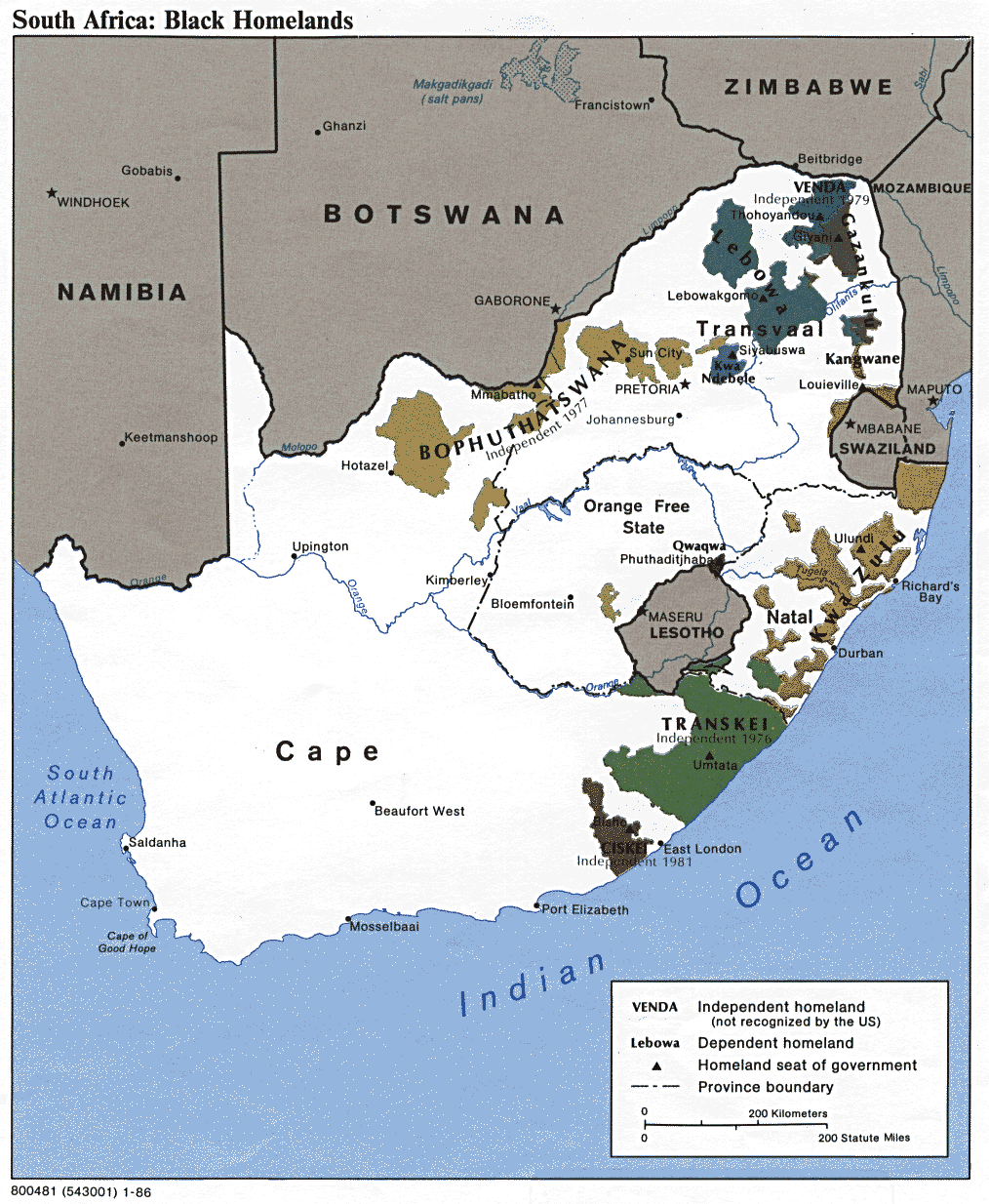
Note: Ten self-governing territories (Homelands) for different black ethnic groups were established as part of the policy of apartheid on the basis of the Promotion of Bantu Self-Government Act of 1959, the Black Homelands Citizenship Act of 1970, and the Bantu Homelands (National States) Constitution Act of 1971. The first of these Acts provided for creation of the ethnic territories on the basis of language and their interim authorities, and the latter for their self-government. Four of the homelands were granted "independence" by South Africa (recognized only by South Africa and each other), these were sometimes together called as the "TBVC states." Some of the homelands had widely scattered territorial units making administration and consolidation difficult. These former South African Homelands or Bantustans ceased to exist 27 Apr 1994 and were re-incorporated into South Africa, and all were absorbed into the new provinces by the Constitution of the Republic of South Africa 1993.
Bophuthatswana
|
|
![[Bophuthatswana
flag 1972-1973 (South African homeland)]](sud_bop3.gif "[Bophuthatswana flag 1972-1973 (South
African homeland)]")
![[Bophuthatswana
flag 1973-1994 (South African homeland)]](za-bop.gif "[Bophuthatswana flag 1973-1994 (South
African homeland)]")
|
|
"Lefatshe leno la bo-rrarona" (This Land of Our Forefathers) |
Adopted 1977 |
(6 Dec 1977) |
|
(Mafeking provisional 1961-1977) |
Rand (ZAR) |
Independence Day |
1,323,315 (1980) |
|
|
Imports: $N/A |
|
|
|
about 4,000 (1993) |
Note: state officially Christian. |
||
| International Organizations/Treaties: CMA, DBSA, ECOSA, SACU, SECOSAF | |||
21 Apr
1961
Tswana Territorial Authority established.
12 Dec
1968
Reorganized, wider
executive powers granted.
1 May
1971
Legislative assembly established.
1 Jun
1972
Bophuthatswana, self-government granted.
6 Dec 1977
Constituted as a sovereign and independent
state in accordance
with the
Status of Bophuthatswana Act, 1977 (Afrikaans:
Wet op
die Status van Bophuthatswana, 1977), passed by
the Senate and
House of Assembly of Republic of South Africa, assented
to on
20 Jun
1977 (effective on 6 Dec 1977).
6 Dec
1977
Declared independent by South Africa (Republic of
Bophuthatswana
[Riphaboliki ya Bophuthatswana = Republiek van
Bophuthatswana]);
(contemporary spelling [Tswana]: Repaboliki ya
Bophuthatswana),
only recognized only by South Africa and the other 'independent'
homelands.
13 Mar 1994 - 27 Apr 1994 Occupied by
South Africa.
27 Apr
1994
Re-incorporated into South
Africa (Status of Bophuthatswana Act,
1977 is repealed by South Africa)(territory was divided
between
the
provinces of Free State, Gauteng, Mpumalanga, and North
West)
Chairman and Chief Executive Officer
Apr 1961 - 1968
Tidimane Ramono Pilane
(b. 1907 - d. 2000)
Chief Executive Officer
1968 - 1 May 1971
Lawrence Lucas Manyane
Mangope (b. 1923 - d. 2018)
Chief Executive Councillor
1 May 1971 - 1 Jun 1972
Lawrence Lucas Manyane Mangope
(s.a.)
Chief minister
1 Jun 1972 - 6 Dec 1977
Lawrence Lucas Manyane Mangope
(s.a.)
BNP;1974 BDP
President
6 Dec 1977 - 13
Mar 1994 Lawrence Lucas Manyane
Mangope (s.a.)
BDP
10 Feb 1988 - 10 Feb 1988 Rocky Ismael
Peter Malabane-Metsing(b. 1949 - d. 2016)
PPP
(in dissidence)
Administrators
13 Mar 1994 - 27 Apr 1994 Tjaart Van der
Walt
(b. 1934 - d. 2019) Ind
+ Tebogo Job
Mokgoro
(b. 1948)
ANC
Commissioner-generals of Tswana (from 1 Apr 1971,
Bophuthatswana)
1 Jul 1960 - 1973
Ignatius Stefanus Kloppers
(b. 1907 - d. 1980)
Jul 1973 - Dec
1977 Gerhardus
"Gerrie" Renier Wessels (b. 1912 - d. 1998)
Territorial Disputes: South Africa was
the only country to recognize
its independence; faced
significant territorial disputes, largely
revolving around its fragmented nature (seven
scattered enclaves); Qwaqwa
disputed Bophuthatswana's control of the Thaba 'Nchu
area, which is mostly inhabited by South Sotho; neighboring Lesotho argued that
Thaba 'Nchu should be part of that country; as a
result of South Africa's efforts to transfer the KaNgwane
homeland and a portion
of KwaZulu homeland to Swaziland, there was interest
among some Botswana officials in absorbing
Bophuthatswana. The idea of reuniting all of the
Tswana people has been discussed among Botswana
officials since the 1960's; Botswana opposed the
construction of damns on the Malopo and Ngotoane
Rivers by Bophuthatswana;
Botswana consistently refused to formally recognize
Bophuthatswana.
Party abbreviations: CDP
= Christian Democratic Party (former BDP, 1991-13 Mar
1994); Mil = Military;
- Former parties: BDP
= Lekoko la Temokerasi la Bophuthatswana
(Bophuthatswana Democratic Party, right-wing, Mangope
personalist, pro-apartheid, economic liberal,
authoritarian, Tswana nationalist, former BNP,
1974-1991, renamed CDP); BNP =
Lekoko la bosetšhaba la Bophuthatswana (Bophuthatswana
National Party, 1972-1974, renamed BDP); PPP
= Progressive People's Party (1987-Feb
1988, banned 1988)
Ciskei
|
|
![[Ciskei flag as
used 1973-1994 (South African homeland)]](za-ck-1.gif "[Ciskei flag as used 1973-1994 (South
African homeland)]")
![[Ciskei flag
design according to official specifications
(South African homeland)]](za-ck-3.gif "[Ciskei flag
design according to official specifications
(South African homeland)]")
|
|
"Nkosi Sikelel'i Afrika" (God, Bless Africa) |
Adopted 4 Dec 1981 |
(4 Dec 1981) |
|
(Zwelitsha provisional to 1968-1981; Alice interim 1961-1968) |
Rand (ZAR) |
Independence Day |
682,880 (1980) |
|
|
Imports: $N/A |
|
|
|
|
|
||
| International Organizations/Treaties: CMA, DBSA, ECOSA, SACU, SECOSAF | |||
1 Jan 1956
Ciskei designated
area for the Xhosa people by South Africa.
1 Apr
1961
Ciskeian Territorial Authority established.
14 Nov
1968
Ciskei given wider executive powers.
1 Jun
1971
Legislative assembly established.
1 Aug
1972
Self-government granted.
1 Dec
1975
Glen Grey and Herschel districts transferred to
Transkei.
16 Oct 1981
Status of Ciskei Act, 1981 (Afrikaans: Wet
op die Status van Ciskei,
1981) is assented to.
4 Dec
1980
Ciskei independence referendum passed 99.45% to 0.55%.
4 Dec
1981
Declared independent by South Africa (Republic of Ciskei
[iRiphabliki yeCiskei]); only recognized only by
South Africa
and the other 'independent' homelands.
22 Mar 1994 - 27 Apr 1994 Occupied by
South Africa.
27 Apr
1994
Re-incorporated into South
Africa (Status of Ciskei Act, 1981
is
repealed by South Africa)(part of Eastern Cape
Province).
Chairman and Chief Executive Officer
8 Nov 1961 - 1968
Archibald Velile
Sandile
(d. 1968)
Chief Executive Officer
Jun 1968 - 1 Jun 1971
Justice Thandathu
Jongilizwe (b. 1926
- d. 2021) CNP
Mabandla
Chief Executive Councillor
1 Jun 1971 - 1 Aug 1972
Justice Thandathu
Jongilizwe (s.a.)
CNP
Mabandla
Chief ministers
1 Aug 1972 - 21 May 1973
Justice Thandathu
Jongilizwe
(s.a.)
CNP
Mabandla
21 May 1973 - 20 Jul 1975 Lennox Leslie
Wongama Sebe
(b. 1926 - d. 1994) CNIP
(1st time)
20 Jul 1975 - 24 Oct 1975 Xhanti Charles
Sebe (acting) (b.
1934? - d. 1991) Mil
24 Oct 1975 - 4 Dec 1981 Lennox
Leslie Wongama Sebe
(s.a.)
CNIP
(2nd time)
President
4 Dec 1981 - 4
Mar 1990 Lennox Leslie Wongama Sebe
(s.a.)
CNIP
(from Jun 1983, President for Life)
Chairman of the Military Committee
and of the Council of State
4 Mar 1990 - 22 Mar
1994 Joshua Oupa Gqozo
(b. 1952)
Mil;1991 ADM
Administrators
23 Mar 1994 - 27 Apr 1994 Pieter van
Rensburg Goosen
+ Bongani Blessing
Finca
(b. 1953)
Commissioner-generals of Ciskei
1 Jul 1960 - 1 Sep 1976 the
Commissioner-generals Transkei
1 Sep 1976 - 4 Dec 1981 Johan
J. Engelbrecht
Territorial Disputes: South Africa was the only country to recognize its independence; Ciskei and Transkei engaged in cross-border raids and political hostilities, with Transkei often trying to dominate or destabilize Ciskei.
Party abbreviations: ADM =
African Democratic Movement (Gqozo
personalist, traditionalist, 8 Jul 1991-1994); CNIP
= iQela leSizwe leNkululeko yeCiskei (Ciskei National
Independence Party, Sebe personalist,
right-wing, Xhosa nationalist, anti-communist,
authoritarian, pro-apartheid, split from CNP, 1978-1990
only legal party, 19 Feb 1973-4 Mar 1990, suspended
1990); CNP = Ciskei National
Party (Mabandla personalist,
1968-1978, merged into CNIP); Mil
= Military
Gazankulu
|
|
![[Gazankulu flag
1973-1994 (South African homeland)]](za-gz.gif "[Gazankulu flag 1973-1994 (South African
homeland)]")
|
|
|
"Hosi Katekisa Afrika" (God, Bless Africa) |
517,227 (1980) |
| GDP: 323,880,000 Rand (1986) |
Exports: $N/A Imports: $N/A |
Ethnic
groups: Shangaan-Tsonga 31.8%, North
Sotho, Venda, Swazi |
|
| Total Police
Force: N/A |
Religions:
Christian 40.3% (African independent churches
(AIC) 20.2%, other Christian 10.7%, Roman
Catholic 0.6%, Methodist 2.5%, NG Dutch Reformed
1.6%, Lutheran 0.6%, Apostolic Faith Mission
[AFM] 0.6%, Anglican 0.4%, Methodist
0.4%), traditional and other 0.6%, none/uncertain 59.1%
(1980) |
||
9 Nov 1962
Matshangana (Changana-Tonga)
Territorial Authority established.
14 May
1971
Renamed Machangana Territorial Authority.
1 Jul
1971
Machangana Legislative Assembly and wider
executive powers granted.
1 Feb 1973
Renamed Gazankulu Territorial Authority, self-rule
granted.
27 Apr
1994
Re-integration into South
Africa (part of Limpopo province).
Chairman and Chief Executive Officer
19 Dec 1962 - Oct 1969 Adolf
Sunduza
Mhinga
(b. 1914 - d. 1992)
Chief Executive Councillor
13 Oct 1969 - 1 Feb
1973 Hudson William Edison
Ntsanwisi (b. 1920 - d. 1993)
Chief ministers
1 Feb 1973 - 25 Mar
1993 Hudson William Edison
Ntsanwisi
(s.a.)
1983: XXP
25 Mar 1993 - 1 Apr 1993 Edward
Percy Mhinga (acting) (b.
1927 - d. 2017) XPP
1 Apr 1993 - 27 Apr 1994 Samuel
Dickenson Weller Nxumalo (b. 1926 - d.
2015) XPP
Commissioner-generals of Shangaan-Tsonga
(from 1 Feb 1973, Gazankulu)
1 May 1970 - 1980
Evert
Frederik Potgieter
(b. 1921 - d. 1996)
1980 - 1985
Jacobus "Kobus" Adriaan Jordaan
(b. 1937)
1 Jun 1985 - 1994
Herman Otto Mönnig
(b. 1928)
Party abbreviations: XPP
= Ximoko Progressive Party (1990-1996, renamed Ximoko
Party); XXP = Ximoko Xa Rixaka
(Whip of the Nation, right-wing, Tsonga nationalist,
anti-communist, authoritarian, pro-apartheid, only legal
party, 1983-1990, renamed XPP)
KaNgwane
|
![[Old flag of
South Africa 1928-1994]](za-1928.gif "[Old flag of
South Africa 1928-1994]")
|
|
(Schoemansdal provisional 1976-1983) |
"Nkosi Sikelel'i Afrika" (God, Bless Africa) |
351,177 (1980) |
| GDP: 151,620,000 Rand (1986) |
Exports: $N/A Imports: $N/A |
Ethnic
groups: Swazi 72.1%, Shangaan-Tsonga, Zulu and North Sotho (1980) |
|
| Total Police
Force: N/A |
Religions:
African independent churches [AIC] 55.3%, Roman
Catholic 3.7%, Methodist 2.5%, NG Dutch Reformed
1.9%, Anglican 0.6%, Congregational 0.6%, Lutheran
0.6%, other Christian 9.9%, none/uncertain 23.6% (1980) |
||
23 Apr
1976
Swazi Territorial Authority established.
1 Oct 1977
KaNgwane Legislative Assembly and wider
executive powers granted.
18 Jun 1982 - 9 Dec 1982
Dis-establishment of the KaNgwane
legislature by South Africa.
30 Sep
1982
South Africa's highest appeals court confirms that the
method
adopted
by the South African government to dissolve the
legislative assembly and transfer the land is illegal.
31 Aug
1984
Self-government granted.
27 Apr
1994
Re-integration into South
Africa (part of Mpumalanga province).
Chairmen and Chief Executive Officers
23 Apr 1976 - 8 Oct 1977 Johannes
Mkolishi Dlamini (b.
1928 - d. 2023)
8 Oct 1977 - 18 Jun 1982 Enos John Mabuza
(1st time) (b. 1939
- d. 1997)
(from Apr 1981, chief executive councillor)
Administrator for the South
African Department
Co-operation and Development (Black Affairs)
18 Jun 1982 - 9 Dec 1982 N.J.
Badenhorst
Chief ministers
9 Dec 1982 - 1
Apr 1991 Enos John Mabuza (2nd
time) (s.a.)
1988:
INP
(chief executive councillor to Aug 1984)
15 Apr 1991 - 27 Apr 1994 Mangisi Cephas
Zitha
(b. 1940)
Commissioner-generals of Swazi (from 1981,
KaNgwane)
1978 - 1 Feb
1982
George Frederik Botha
(b. 1912 - d. 19..)
Feb 1982 - Jan
1988 Theunis
Nicolaas Hendrik "Punt" (b. 1917 - d.
1988)
Janson
1988 -
199.
H.J. Tempel
Territorial Disputes: The South African government's efforts to transfer the KaNgwane homeland, and the Ngwavuma northern portion of KwaZulu homeland, to Swaziland was resisted by the KaNgwane authorities and following King Sobhuza II's death by Swaziland; the homeland was claimed by King Sobhuza and irredentists of Swaziland as part of the Swazi traditional realm.
Party abbreviations: INP
= Inyandza National Movement (progressive,
anti-apartheid, Oct 1978-1990, merged into ANC); IsNP
= Inzika National Party
KwaNdebele
|
|
![[KwaNdebele flag
1982-1994 (South African homeland)]](za-kndb.gif "[KwaNdebele flag 1982-1994 (South African
homeland)]")
|
|
(Siyabuswa interim 1977-1986) |
"Nkosi Sikelel'i Afrika" (God, Bless Africa) |
Moutse- 130,000 (1986) 157,455 (1980) |
| GDP: 509,500,000 Rand (1986) |
Exports: $N/A Imports: $N/A |
Ethnic
groups: South Ndebele, North Sotho, Pedi,
others |
|
| KwaNdebele Police (KNP): N/A | Religions:
African independent churches [AIC] 53.2%,
NG Dutch Reformed 5.8%, Roman Catholic 5.1%,
Anglican 1.9%, Congregational 1.9%, Lutheran
1.9%, Methodist 1.3%, Apostolic Faith Mission
[AFM] 1.3%, other Christian 12.2%,
none/uncertain 15.4% (1980) |
||
7 Oct
1977
Ndebele Territorial Authority
established.
1 Oct 1979
KwaNdebele, legislative assembly and
wider executive powers
established.
1 Apr
1981
Self-government granted.
12 Aug 1986
Legislative Assembly rejects
independence scheduled for 11 Dec 1986.
6 May 1987
Legislative Assembly makes
unanimous decision to opt for
independence. However, South Africa requests a
referendum be held.
29 Mar 1988 - 27 Apr 1994 Moutse district
(added 1986) administered by South Africa.
27 Apr
1994
Re-integration into South
Africa (part of Mpumalanga province).
Chairman and Chief Executive Officer
7 Oct 1977 - 30 Sep 1979 Simon
Somkhahlekwa
Skosana
(b. 1927 - d. 1986) Non-party
Chief Executive Councillor
1 Oct 1979 - 1 Apr 1981 Simon
Somkhahlekwa
Skosana
(s.a.)
Non-party
Chief ministers
1 Apr 1981 - 17 Nov 1986 Simon
Somkhahlekwa
Skosana
(s.a.)
Non-party
17 Nov 1986 - 27 Nov 1986 Klaas Mtshiweni
(acting)
27 Nov 1986 - 3 Feb 1989 Prince
George Majozi Mahlangu (b.
1951)
3 Feb 1989 - 30 Apr
1990 Prince Jonas Masana Mabena
(b. 1936)
30 Apr 1990 - 27 Apr 1994 Prince
Senzangakhona James
(b. 1953 - d.
2005) IYS
Mahlangu
Commissioner-generals of KwaNdebele
1 Oct 1979 - 1981
J.A. van Tonder
1 Oct 1981 - 30 Jun 1985 Johan H.T.
Mills
1 Jul 1985 - 20 Sep 1986 Gerrie J.
van der Merwe
1986 -
1987
....
1 Jun 1987 -
199.
P.J.K. Kriel
Party abbreviations: Con
= Contralesa (Congress of Traditional Leaders of South
Africa, traditionalist, anti-apartheid, est.1987);
IYS = Intando yeSizwe (The Will
of the Nation Party, 1988-1994, merged into ANC)
KwaZulu
|
|
![[KwaZulu flag
1977-1984 (South African homeland)]](za-zu-1.gif "[KwaZulu flag 1977-1984 (South African
homeland)")
![[KwaZulu flag 1984-1994 (South
African homeland)]](za-zu-2.gif "[KwaZulu flag 1984-1994 (South African
homeland)]")
|
|
(Nongoma provisional 1977-1980) |
"Nkosi Sikelel'i Afrika" (God, Bless Africa) |
3,482,690 (1980) |
| GDP: 1,434,540,000 Rand (1986) |
Exports: $N/A Imports: $N/A |
Ethnic
groups: Zulu 96.7%, Xhosa 1.3%, South Sotho 0.52%, White 0.5%, Swazi 0.3%, Indian 0.2%, Tswana
0.14%, North Sotho 0.07%, Coloured 0.06%, Shangaan/Tsonga
0.05%, other Black 0.05% (1980) |
|
| Total Police Force: N/A | Religions: African independent churches [AIC] 31.9%, Roman Catholic 14.4%, Methodist 6.8%, Anglican 5%, Lutheran 4.9%, other Christian 4.4%, Presbyterian 1.8%, Congregational 1.5%, NG Dutch Reformed 1%, traditional and other 0.8%, Apostolic Faith Mission [AFM] 0.3%, Hindu 0.1%, none/uncertain 27.2% (1980) | ||
1 Jun
1970
Zululand Territorial Authority established.
1 Apr
1972
KwaZulu legislative assembly and wider
executive powers granted.
1 Feb
1977
Self-government granted.
27 Apr
1994
Re-integration into South
Africa (part of KwaZulu-Natal province).
Chairman and Chief Executive Officer
9 Jun 1970 - 31 Mar 1972 Mangosuthu
Gatsha Buthelezi
(b. 1928 - d. 2023)
Chief Executive Councillor
1 Apr 1972 - 31 Jan 1977 Mangosuthu
Gatsha
Buthelezi
(s.a.)
1975:INCLM
Chief minister
1 Feb 1977 - 27 Apr 1994 Mangosuthu
Gatsha
Buthelezi
(s.a.)
INCLM;
Gatsha Buthelezi
1990 IFP
Commissioner-generals of Zulu (from 1 Apr 1972,
KwaZulu)
1 Jul 1960 - 1965
Cornelius
Gert Nel
(b. 1908 - d. 1970)
1 Aug 1965 -
1970
Johannes Jeremias Boshoff
(b. 1895 - d. 1984)
1970 - Jul
1979
Philip Heinrich "Henry"
Torlage
(b. 1909 - d. 1987)
1 Aug 1979 - 1989
Paul
Nicholaas "Nico" Hansmeyer
(b. 1921 - d. ....)
1 Jan 1989 -
199. C.
Anthony "Tony"
Erskine
(b. 1932)
Territorial
Disputes:
Buthelezi consistently opposed
"independence"; South
Africa's efforts to transfer the Ngwavuma northern
portion of KwaZulu homeland
to Swaziland was
opposed by Buthelezi and was resisted by Swaziland after the death of King
Sobhuza II.
Party abbreviation: INCLM
= Inkatha Yenkululeko Yesizwe (Crown
National Cultural Liberation Movement, populist, Zulu
nationalist, conservative, anti-communist, KwaZulu-Natal
regionalist, 21 Mar 1975-14 Jul 1990, renamed IQembu
leNkatha yeNkululeko/Inkatha Freedom Party
[IFP])
Lebowa
|
|
![[Lebowa flag 1974-1994
(South African homeland)]](za-le.gif "[Lebowa flag
1974-1994 (South African homeland)]")
|
|
(Seshego interim to 1974) |
"Nkosi Sikelel'i Afrika" (God, Bless Africa) |
1,755,874 (1980) |
| GDP: 733,710,000 Rand (1986) |
Exports: $N/A Imports: $N/A |
Ethnic
groups: North Sotho 80.6%, Shangaan/Tsonga
7.1%, North Ndebele 5.9%, South Ndebele 1.6%,
Swazi 1.5%, Zulu 0.9%, Venda 0.3%, White 0.25%,
South Sotho 0.24%, Griqua 0.21%, Xhosa 0.18%, other Black 0.2% (1980) |
|
| Total Police Force: N/A | Religions: African independent churches [AIC] 24.7%, Roman Catholic 7.4%, Lutheran 7.1%, other Christian 4.6%, Dutch Reformed NG 4%, Anglican 1.5%, Methodist 1.5%, Presbyterian 1%, traditional and other 0.8%, Apostolic Faith Mission [AFM] 0.2%, Congregational 0.2%, none/uncertain 46.8% (1980) | ||
1 Jun
1960
North Sotho National Unit formed.
1 Sep 1962
Lebowa Territorial Authority
established.
2 May
1969
Wider executive powers granted.
1 Jul 1971
Lebowa legislative assembly established.
2 Oct 1972
Self-government
granted.
27 Apr
1994
Re-integration into South
Africa.
Chief ministers
1 Sep 1962 - 8 May 1973
Mokgoma Maurice Maserumule Matlala(b. 1924 - d.
2021) LNP
(chairman and chief executive officer to 14 Aug 1969,
chief executive councillor 14 Aug 1969 - 2
Oct 1972)
8 May 1973
- 7 Oct 1987 Cedric Makepeace
Namedi
(b. 1912 - d. 1987) LPP
Phatudi
7 Oct 1987 - 21 Oct 1987 Zacharia
Tompi Seleka (acting)
LPP
21 Oct 1987 - 27 Apr 1994 Mogoboya Noko
Nelson Ramodike (b. 1941 - d.
2012) LPP
(from 1989, Prime minister)
Commissioner-generals of North Sotho (from 1
Jul 1971, Lebowa)
1 Jul 1960 - 1971
Werner Willi
Max Eiselen (b. 1899 –
d. 1977)
1972 - 1977
Gert Pieter
Christiaan
(b. 1919 - d. 1977)
Bezuidenhout
1977 - 1982
Roelof
McLachlan
(b. 1916 - d. 1982)
1982 - 31 Jan
1988
Petrus Johannes Visser Erasmus (b. 1919 -
d. 2008)
Pretorius
Mar 1988 - 22 Nov 1989
Nicolaas Johan
Nieuwoudt
(b. 1929 - d. 1989)
1 Apr 1990 - Nov 1992
J. Martin "Thabo" Koekemoer
(b. 1938)
1992 -
1994
....
Territorial Disputes: Lebowa government
rejected "independence" for Lebowa.
Party abbreviations: LNP
= Lebowa National Party (traditionalist, merged into LPP
on 18 Mar 1974); LPP = Lebowa
People's Party (economic liberal, from 1988 renamed
Thari ya Setshaba, est.1973)
Qwaqwa
|
|
![[Qwaqwa flag 1975-1994
(South African homeland)]](za-qq.gif "[Qwaqwa flag
1975-1994 (South African homeland)]")
|
|
(Witsieshoek 1969-1974) |
"Nkosi Sikelel'i Afrika" (God, Bless Africa) |
158,328 (1980) |
| GDP: 151,990,000 Rand (1986) |
Exports: $N/A Imports: $N/A |
Ethnic
groups: South Sotho (Basotho) 1.7% |
|
| Total Police Force: N/A | Religions: Dutch Reformed NG 24.1%, African independent churches [AIC] 16.4%, Roman Catholic 9.5%, other Christian 9.5%, Methodist 8.9%, Anglican 5.7%, Presbyterian 4.4%, traditional and other 0.6%, none/uncertain 9.5% (1980) | ||
1 Apr
1969
Basotho Ba Borwa (South Sotho) Territorial
Authority established.
1 Oct
1971
Legislative assembly established.
1 Apr
1972
Basotho Qwaqwa
1 Nov
1974
Qwaqwa (self-rule achieved).
27 Apr
1994
Re-integration into South Africa (part of
Free State province).
Chairman and Chief Executive Officer
Apr 1969 - 1 Oct 1971
Wessels
Mota
(b. 1920 - d. 1988)
Chief Executive Councillor
1 Oct 1971 - 1 Nov 1974 Wessels
Mota
(s.a.)
1974: BUP
Chief ministers
1 Nov 1974 - 19 May 1975 Wessels
Mota
(s.a.)
BUP
19 May 1975 - 27 Apr 1994 Tsiame Kenneth
Mopeli
(b. 1930 - d. 2014) DP
Commissioner-generals of South
Sotho (1972-74 Basotho Qwaqwa; from
1
Nov 1974 Qwaqwa)
1 Jul 1960 - Apr 1970
Simon Frederik Papenfus
(b. 1905 - d. 1978)
1970 - 1975
Nicolaas Christiaan "Chris" van
(b. 1913 - d. 1987)
Rooyen Sadie
1 Oct 1975 - 9 Nov 1983
Jacobus Stephanus "Kosie"
(b. 1918 - d. 2010)
Pansegrouw
1983/84 -
1985
J.M. van Rooyen
(b. 19.. - d. 1985)
1 Jul 1985 - 14 Mar 1990 David
"Dawie" McKenzie Grewar
(b. 1927 - d. 1990)
16 May 1990 - 1994
Willem Adriaan Odendaal
(b. 1944)
Territorial Disputes: Qwaqwa
has long disputed Bophuthatswana's control of the
Thaba 'Nchu area, which is mostly inhabited by South
Sotho; neighboring
Lesotho argued that Qwaqwa and Thaba 'Nchu should be
part of that country; Khoptjoane dispute with
neighboring Lesotho.
Party abbreviations: BUP = Basotho
Unity Party (est.1974); DNP = Dikwankwetla Party
(founded as Dikwankwetla National Party, governing party
1975-1994, est.1974)
Transkei
|
|
![[Transkei
provisional flag 1964-1966 (South African
homeland)]](transkst.gif "[Transkei provisional flag
1964-1966 (South African homeland)]")
![[Transkei flag
1966-1994 (South African homeland)]](za-trkei.gif "[Transkei flag 1966-1994 (South African
homeland)]")
|
|
"Nkosi Sikelel' iAfrika" (God, Bless Africa) |
Adopted 26 Oct 1976 |
(26 Oct 1976) |
|
|
Rand (ZAR) |
Independence Day |
2,323,650 (1980) |
|
|
Imports: $N/A |
|
|
|
|
|
||
| International Organizations/Treaties: CMA, DBSA, ECOSA, SACU, SECOSAF | |||
1 Sep 1956
Transkeian Territorial Authority established.
24 Mar 1961
Transkei Territorial Authority
30 May
1963
Self-government and wider executive powers
granted by the Transkei
Constitution Act.
24 Jun 1976
Status of the Transkei Act, 1976
(Afrikaans: Wet op die Status van
die Transkei, 1976) is assented to.
26 Oct
1976
Declared independent by South Africa (Republic of
Transkei
[iRiphabliki ye Transkei = Rephaboliki ya
Transkei = Republiek
van
Transkei])(Xhosa was the sole official language
according
to the Constitution of 1976; Sesotho, English and
Afrikaans
were confirmed for legislative use); only recognized
only by
South Africa and the other 'independent' homelands.
27 Apr
1994
Re-incorporated into South
Africa (Status of Transkei Act, 1976
is repealed by South Africa)(part of Eastern Cape
province).
Presidents (Prezidanti)
26 Oct 1976 - 1 Dec 1978 Botha
Manzolwandle Jongilizwe
(b. 1913 - d. 1978) NIPT
Sigcau
1 Dec 1978 - 20 Feb 1979 Zwelibanzi
Maneli Mabandla (acting)(b. 1906 - d. 19..)
20 Feb 1979 - 20 Feb 1986 Kaiser
Daliwonga Matanzima
(b.
1915 - d. 2003) NIPT
20 Feb 1986 - 27 Apr 1994 Tutor
Nyangilizwe Vulindlela (b. 1921 -
d. 1997) NIPT;1987
Ndamase
Non-party
Chairmen and Chief Executive Officers
1 Sep 1956 - 26 May
1959 Sabata Jonguhlanga Dalindyebo
(b. 1928 - d. 1986)
26 May 1959 - Mar 1961 Botha
Manzolwandle Jongilizwe
(s.a.)
Sigcau
Chief Executive Councillor
24 Mar 1961 - 6 Dec 1963 Kaiser
Daliwonga Matanzima
(s.a.)
Chief minister
6 Dec 1963 - 26 Oct 1976 Kaiser
Daliwonga Matanzima
(s.a.)
1964: NIPT
Prime ministers
26 Oct 1976 - 20 Feb 1979 Kaiser
Daliwonga Matanzima
(s.a.)
NIPT
20 Feb 1979 - 24 Sep 1987 George Mzimvubu
Matanzima
(b. 1918 - d. 2000) NIPT
25 Sep 1987 - 5 Oct 1987 Dumnisani
Gladstone
Gwadiso (b.
1952)
NIPT
(acting)
5 Oct 1987 - 30 Dec 1987
Stella Margaret Nomzano Sigcau (f) (b. 1937 - d.
2006) NIPT
Chairman of the Military Council and of the
Council of Ministers
30 Dec 1987 - 27 Apr 1994 Harrington
Bantu
Holomisa
(b.
1955)
Mil
Commissioner-generals for the Xhosa (from 1961,
Transkei and Ciskei)
1 Jul 1960 - 31 May 1974 Johannes
"Hans" Hendrikus Abraham (b. 1908 – d. 1978)
31 May 1974 - 26 Oct 1976 D.H. "Danie"
Potgieter
Territorial Disputes: South Africa was the only country to recognize its independence; Transkei and Ciskei engaged in cross-border raids and political hostilities, with Transkei often trying to dominate or destabilize Ciskei.
Party abbreviations (from Dec 1987
parties banned): NIPT
= iQela leTranskei leNkululeko (National Independence
Party of Transkei, pro-independence, Xhosa nationalist,
pro-apartheid, 1964-30 Dec 1987); Mil
= Military
Venda
|
|
![[Venda flag
1973-1994 (South African homeland)]](za-venda.gif "[Venda flag 1973-1994 (South African
homeland)]")



|
|
"Pfano na vhuthihi" (Peace and Togetherness) |
Adopted 1979 |
(13 Sep 1979) |
|
(Sibasa [Makwarela] provisional to 1979) |
Rand (ZAR) |
Independence Day |
315,545 (1980) |
|
|
Imports: $N/A |
Ethnic groups: Venda (vhaVenda) 66.9%, others | |
|
|
|
||
| International Organizations/Treaties: CMA, DBSA, ECOSA, SACU, SECOSAF | |||
#/media/File:Map_of_Venda_with_boundary_changes_from_independence_to_dissolution.svg)
1 Dec 1962
Thohoyandou (Vendaland) Territorial
Authority formed.
23 May
1969
Venda Territorial Authority
20 Jun
1969
Venda given wider executive powers.
1 Jun 1971
Venda
legislative assembly established
1 Feb
1973
Self-government achieved.
2 Jul 1979
Status of Venda Act, 1979 (Afrikaans: Wet op die
Status van Venda,
1979) is assented to.
13 Sep
1979
Declared independent by South Africa (Republic of Venda
[Riphabuliki ya Venda = Republiek van Venda]);
only recognized
by South Africa and the other 'independent'
homelands.
1990
English is
recognized as the official language (Venda and
Afrikaans may be used for judicial and administrative
purposes).
27 Apr
1994
Re-incorporated into South
Africa (Status of Venda Act, 1979
is repealed by South Africa)(part of Limpopo province).
Presidents
13 Sep 1979 - 17 Apr 1988 Patrick Ramaano
Mbulaheni Mphephu (b. 1925 - d. 1988)
VNP
17 Apr 1988 - 5 Apr 1990 Frank
Nndwakhulu Ravhele
(b. 1926 - d. 1999) VNP
(acting to 10 May 1988)
Chairmen of the Council of National Unity
5 Apr 1990
- 25 Jan 1994 Gabriel Mutheiwana Ramushwana
(b. 1941 - d. 2015) Mil
25 Jan 1994 - 27 Apr 1994 Tshamano Gerso
Ramabulana
(b.
1940 - d. 2020) Mil
Chairman and Chief Executive Officer
1962 - Jun 1969
Patrick Ramaano Mbulaheni
Mphephu (s.a.)
Chief Executive Officer
Jun 1969 - 1 Jun
1971 Patrick Ramaano Mbulaheni
Mphephu (s.a.)
Chief Executive Councillor
1 Jun 1971 - 1 Feb 1973 Patrick
Ramaano Mbulaheni Mphephu (s.a.)
Chief minister
1 Feb 1973 - 13 Sep 1979
Patrick Ramaano Mbulaheni Mphephu
(s.a.)
VIPP;1974 VNP
Commissioner-generals of the Venda
(and to 1969, Tsonga)
Apr 1966 - 24 Mar 1975
Michiel Daniel Christiaan
de (b. 1901 - d.
1984)
Wet Nel
1 May 1975 - 12 Sep 1979
Johannes Cornelius Otto
(b. 1910 - d. 1985)
Territorial Disputes: South Africa was the only country to recognize its independence.
Party abbreviations: VNP
= Dzangano la lushaka la venda (National Party of Venda,
traditionalist, far-right, Venda nationalist,
authoritarian, pro-apartheid, anti-communist, only legal
party de facto 1978/de jure Aug 1986 - 5 Apr 1990,
est.1973-5 Apr 1990); Mil = Military
© Ben Cahoon